In Tribute
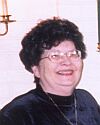 Mary Elizabeth Kepshire
October 14, 1931 - February 5, 2003.
Mary Elizabeth Kepshire
October 14, 1931 - February 5, 2003.
Mary Kepshire, my Mother, was the inspiration and sole reason for all the research and work on my Monon related websites. During her struggles with lengthy hospitalizations and disease, I started documenting what was left of the Monon in and around northwest Indiana. During a hospitalization in 1997, finding three old snapshots blossomed into a project that ultimately resulted in this effort to document the 1952 wreck. December of 2001 found Mom back in the hospital, first in Munster Community and later St. Margarets in Hammond. This hospitalization was also lengthy and to break up one weekend visit, I started exploring downtown Hammond, looking for traces of the old Monon. The days turned into weeks, and the weeks into months. To break up my daily visit, or on my journey to and from a visit, I would wander the former Monon, taking pictures, and documenting what developed into my Bygone Monon website.
Mom, you are finally at peace. Free of pain and reunited with those in our family that have passed before you. Reunited with Daddy once again. As my journey through life continues, I will always keep your memory fresh in my mind and heart. Many times I said how much I love you. What I would not give at this moment to tell you one more time how much I love and will miss you. Rest in peace, Mom, you lived a rich and full life and have earned your final eternal rest.
Eyewitness Account of the Accident
The following account is that of Mary (Hepp) Kepshire, otherwise known
as my Mother. My Grandfather's family resided at 117 W. Commercial
Avenue , approximately 50 yards west of the crossing. Her father, John Hepp,
owned a tavern which in 1952 stood between the Lowell depot and Cedar Creek,
on Commercial Avenue in front of the American Legion Post 101. I'm sure
that over the years, I was told the story of the wreck, but probably never
paid very much attention to the details. Several years ago, while looking
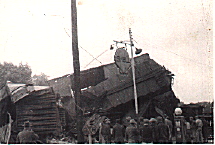
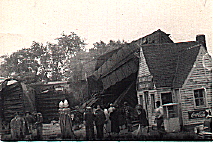
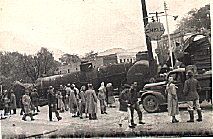
through old family pictures, I happened upon three snapshots of the wreck.
They prompted me to inquire into the events of the night of May 22, 1952.
As it turns out, my whole existence may have been affected by this accident.
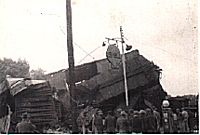 Looking
toward the Southeast, from the north side of Commercial Avenue.
Looking
toward the Southeast, from the north side of Commercial Avenue.
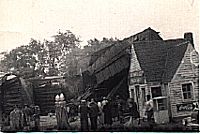 Looking east towards downtown from South side of Commercial
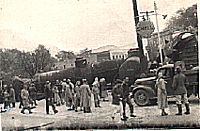 Taken from Commercial Avenue, looking east.
"The evening was getting late. My boyfriend, Ed, had just
left our house on his way back to Chesterton, Indiana. I was sitting in
our living room talking with my mother. All of a sudden we heard the most
ear splitting noise, which kept getting louder and louder. Dad came downstairs
in a hurry and said that something was wrong with the train coming through
town. It turned out he was right.
The noise continued and it became apparent that more and more
train cars were bumping against one another and screeching. We ran out
to the street and was shocked by the scene. The entire crossing was ablaze.
The fire roared as the train cars continued to pile one on top of another.
They just kept ramming into one another and at one point they looked at
least five cars high. We just stood there in utter disbelief. I panicked
because a neighbor on our side of the tracks said that something had to
have derailed the train. My thoughts and concern was on Ed. Visions of
my boyfriend at the bottom of the pile left me feeling scared. I knew that
it normally took Ed an hour to drive home. All I could do is wait, hope
and pray.
Dad attempted to get our car out of the driveway, but it was just
impossible. Autos waiting to cross the tracks were now backed up past our
driveway. Soon the fire departments started to arrive on the scene and
needed room to operate and attack the fire, so we were basically stuck.
If the wind shifted and things on the west side of Commercial started burning,
my family would be in a bad way. We feared that in that event, our best
chance was to actually run away. We kept hearing reports that the entire
downtown was on fire and burning. Someone said that a river of gasoline
was flowing right into the downtown, burning the buildings on the south
side of the street. Dad's business was on the east side of the tracks,
between the depot and Cedar Creek. He had a very bad habit of always leaving
large amounts of cash down there each night. He was concerned for his business,
however, there was no way he could get across the tracks. Something only
200 yards normally from our house, not seemed like miles. Had the fire
consumed Dad's business? Dad finally contacted his brother, Uncle Garda,
to try and get downtown. He lived further west that us, so he was able
to get his vehicle out. To get to downtown, Uncle Garda had to drive south
to the next crossing open, Belshaw Road. Once on the east side of the tracks,
they worked their way to downtown the best way they could. Uncle Garda
said it was a mess. He did manage to reach the tavern, which was still
standing untouched by the fire that had consumed the depot. I guess that
the curbs on Commercial and the drains on the bridge saved the tavern.
Garda was able to get the money and returned home the same way. He then
told us that things were not as bad as the rumors we were hearing.
I remember vividly the firemen from Cedar Lake, Schneider, St.
John and Crown Point were battling the fire on our side of the tracks.
I'm not sure what departments were on the east side, but the papers later
claimed Lowell, Shelby, Lake Dalcarlia and Gary. Besides the old depot,
the train cars destroyed the Shell station on the south side of Commercial
Avenue next to the crossing. I sat on top of the stairs on our front walk
watching the fire and the train cars. The gasoline station on the north
side of Commercial Avenue was saved by the efforts of Harold Love, who
kept water on the top of the building with a garden hose until the fire
departments took over. Damaged train cars kept dropping, each time it made
a frightening crashing sound.
Finally, the hour was up and I called Ed. I was happy to know
that he was home, safe and sound. Ed told me that he had crossed the track,
just as the warning light came on, indicating that the train was approaching.
Not really paying attention, he told me he then heard a big bang, like
an explosion. About this time he was past downtown, just starting into
the curve by the cemetery, but just kept heading east. Ed then said that
when he reached Route 231 and turned north, the western sky was brilliant.
He knew something had happened but realized there was little he could do
and continued home.
Happy that my boyfriend, and future husband, was not hurt lying
under the wreck, I decided to try and head off to bed. I had to work the
next day, so I decided to sleep in the front bedroom. Mom and Dad would
be up all night watching and guarding things. Ever time I would try and
doze off another train car would drop with a loud crash. Finally about
5 AM, I gave up trying to sleep and started filling myself with coffee.
I wandered outside in the daylight to see what was left of the town. I
took some pictures and just stood there wondering what this twisted mass
of metal would reveal. The Shell station was pretty much gone, which is
about all we could see from the west side of the tracks. I spoke with some
firemen, who had worked through the night fighting the fire and he assured
me that there was still a Town of Lowell. The downtown was untouched by
the wreck or the fire. The old Monon depot was lost, but no other buildings
were lost. The contents of the tank cars ran into the creek. Dad's tavern,
the beauty shop and the American Legion Post were all between the tracks
and the creek. All were still standing, undamaged.
That day, weary, I did get into work at the title company. I was
even able to pick up my rides because none of them lived as close to the
tracks as us. The rumor mill was working overtime that morning. According
to reports Lowell had been completely destroyed that night. Besides the
wreck and fire, one other memory of the wreck was the cases of Vienna sausages
that Dad brought home. They had been in several boxcars. I had never heard
of Vienna Sausages but they made good meals. I suppose that by today's
standards what Dad did would be considered looting? A few minutes, one
way or another could have gravely affected mine and my children's existence."
- Mary Kepshire February 22, 2000-
Return to main page.