James Baker
April 9, 1917 - June 22, 2001
On June 22, 2001 Jim Baker passed away. My condolences to his family.
From 1944 to 1960 Jim served his community as a member of the The Lowell Volunteer Fire Department and was one of the first firefighters on the scene the night of the derailment
and fire. Between shifts fighting the fire, Jim was able to
shoot a few photographs. I remembered Jim from my childhood and when several Lowell Firemen advised me that Jim had several photos of the fire and aftermath, I contacted him. I was impressed with his collection and the story of what his part was in the diaster. We spoke a length on several occasions and every time I left Jim's house, there was a smile on his face and one or more additional pictures for my collection. The pictures displayed here are those he gave to me to use and keep. Thank you Jim. First for the pictures and second for taking the time to provide some memories of how it was down there that morning. He was proud of his contribution to my website and spoke about it often. Jim, the pleasure was all mine.
All pictures are courtesy of Jim Baker and used with his permission.
(Click on image to view full size.)
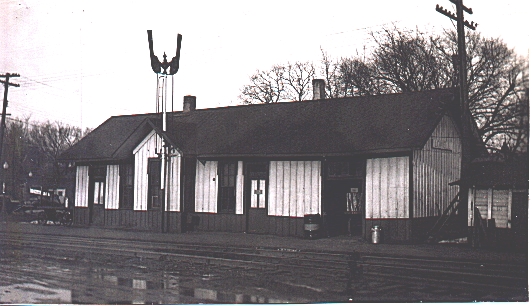
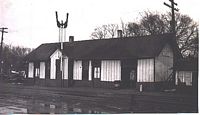 Lowell Depot, circa 1950.......
Before the accident.
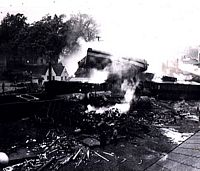 The Lowell Depot...1952...
After the accident.
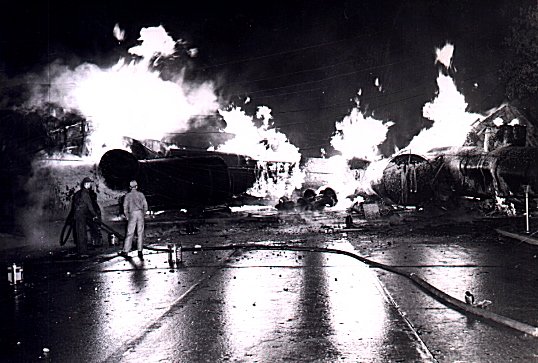
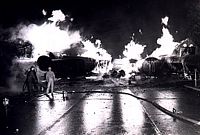 This was the scene after the engines from the Lowell Fire Department
arrived at the crossing.
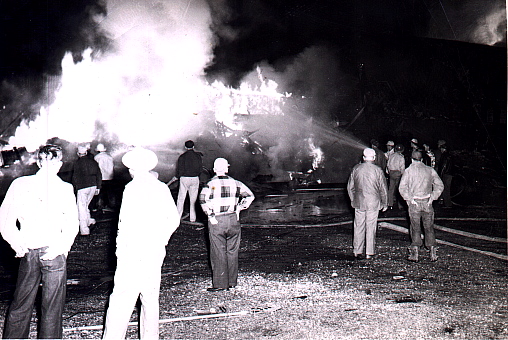
This was the scene after the engines from the Lowell Fire Department
arrived at the crossing.
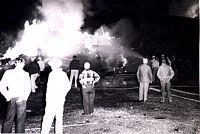 Just another morning at the office? Any one bring the hotdogs? Another
picture of the fire.
Just another morning at the office? Any one bring the hotdogs? Another
picture of the fire.
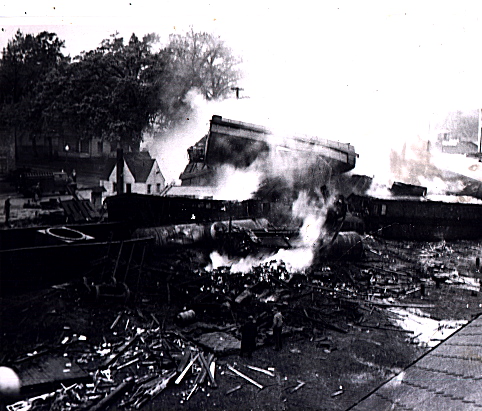
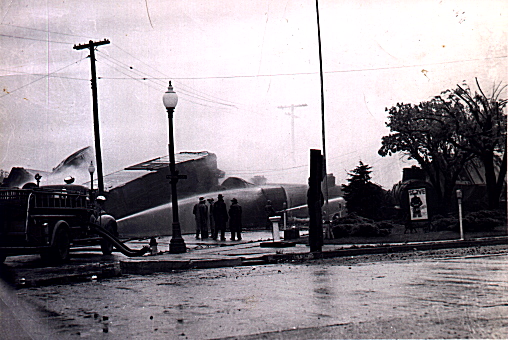
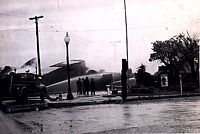 This
picture was taken by Baker at the "Wye". This is where
Commercial jogs off to the left and Washington Street heads straight. This
picture was taken around 7 am according to Jim.
This
picture was taken by Baker at the "Wye". This is where
Commercial jogs off to the left and Washington Street heads straight. This
picture was taken around 7 am according to Jim.
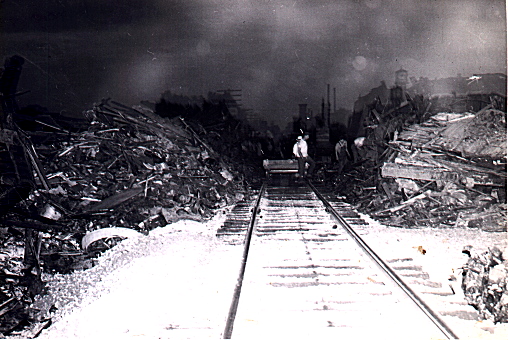
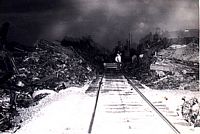 Here is another impressive shot. According to Jim, he was standing
just south of where the destroyed depot would have been and snapped this
picture the evening of the wreck. The Monon was attempting to clear and
repair the mainline and just made piles of debris on either side of the
tracks.
Here is another impressive shot. According to Jim, he was standing
just south of where the destroyed depot would have been and snapped this
picture the evening of the wreck. The Monon was attempting to clear and
repair the mainline and just made piles of debris on either side of the
tracks.
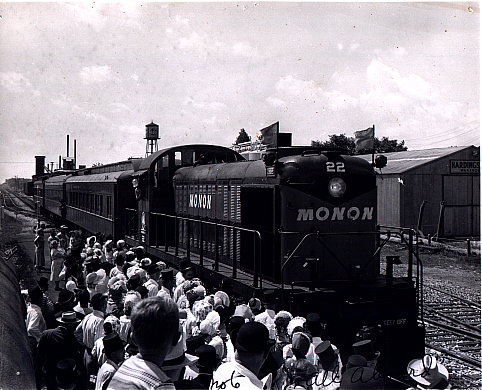
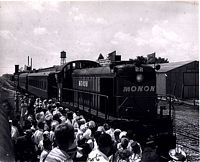 This picture was of a group of townspeople dressed in costume for
the Lowell Centennial embarking on a trip to Chicago in 1952. Look closely
at the left side of the photo. As a temporary depot, the Monon, used an
old passenger car. The roof of the temporary depot is visible in this picture.
This picture was of a group of townspeople dressed in costume for
the Lowell Centennial embarking on a trip to Chicago in 1952. Look closely
at the left side of the photo. As a temporary depot, the Monon, used an
old passenger car. The roof of the temporary depot is visible in this picture.
Interview with Jim Baker, Lowell Volunteer
Fireman
February - March 2000
Jim Baker responded with the Lowell Volunteer Fire Department that
morning. Over the course of two Saturday afternoons I spoke with Jim about
his part in the fire fighting. Originally I requested Jim to write down
his recollections of the fire, but he was reluctant. Instead, he answered
many of my questions concerning the wreck and fire. Lacking a stenographer,
Jim, I hope I put it down as close to how you related the story to me.
Q: At the time of the accident, can you remember exactly where you
were?
A. "Well, at that time we were living in the apartments across
the street from the town library. You would probably remember it as the
Town Hall. Right next to the Three Creeks War Monument. About three blocks
or so from the crossing."
Q: As a volunteer, how did you arrive at the scene of the wreck? Did
you arrive on a fire engine, or personal vehicle?
A. "When the siren went off it woke me up. I can't remember
what the exact time was, but it was early morning, but I can't recall the
exact time. Living a short distance from the Fire Station, I went right
down the hill to the station. I rode on one of our pumpers, but I really
don't recall which one. Lowell only had two pumpers at the time and a water
wagon. They call them tankers today. I really don't recall if you could
see the fire from our apartment. When we left the station, I seem to recall
the sky towards downtown lit up, but to be completely honest, I'm not really
sure of it."
Q: On seeing the scene, what do you recall?
A. "When we left the fire station, we had to head south.
Then west on Commercial Avenue. Commercial Avenue curves to the left as
you get close to the tracks. As we came down the street I remember seeing
the flames. Some people have described the fire as a wall of flames. I
really can't remember how high, or far the fire was when we first arrived.
I do recall the burning alcohol running in the gutters towards downtown.
When the alcohol entered the sewers, several man hole covers were blown
into the air. It scared people, who probably thought these explosions were
more tank cars exploding, or getting ready to explode.
We hooked up to a fire hydrant and started fighting the fire.
I believe we were able to get hooked onto the hydrant at the wye, but I
could be wrong. The scene was pretty well lit up by the burning alcohol
and the cars stacked one on top of another and the demolished and burning
depot was pretty overwhelming. Naturally, we could only speculate on what
was going on west of the crossing. All of our fire trucks and men lived
on the east side. We hoped someone had the brains to call other departments.
There were two service stations next to the crossing. Nobody knew if they
were burning or not. Many people later said that the intense heat blew
out windows in Hardings and the Mobile station. For a while, people were
afraid we might loose the downtown. I never thought that the town was in
that much danger, but the potential was there. Besides the depot and the
mess left by the freight cars, I don't recall the damage being that bad.
Broken windows, maybe some peeled paint due to the heat. The Legion building
wasn't damaged, unless you count the molasses , fuel oil and canned meat
that littered the parking lot and grounds. I know Hepp's Tavern was undamaged,
same for the beauty shop. Considering the path of the burning alcohol,
I'm sort of surprised neither were not touched.
Q: You stayed on the scene all through the morning. At first daylight,
what were your first impressions of what it looked like?
A: "Besides being dog tired, I was really shocked at the
site of all the freight cars piled up where the depot used to be. That
was pretty impressive. The two tanks cars that the majority of the alcohol
leaked from sat in the crossing all charred. I remember it was a little
foggy that morning. The fog and smoke made for an eerie scene."
Q: Can you remember exactly when you were relieved from the fire.
A: "The department remained on the scene for a day or two.
I remember leaving the scene in the morning to go to work. I worked at
the Sinclair station and after opening up, I returned to the fire scene.
We had many spot fires throughout the morning. I remember the railroad
sending down men and equipment to start clearing the mess while we were
still extinguishing fires. I recall members of the department being there
one or two days."
Q: Any lasting memories? What was it like fighting a fire like that?
A: "One thing that to this day I will never forget is the
scene of all the burnt, twisted freight cars stacked one on top of another.
It was just unreal. Where the old depot once stood was now a smoldering
foundation. Another lasting memory, the heat of the fire. You must remember,
in those days we didn't have the flame retardant fire clothing they have
these days. We had rubber hip boots and rubberized fire coats. Get to close
and they became rather warm, very quickly. I was a nozzle man, so I was
sitting on the end of the hose, with only a stream of water between me
and the blaze. Yes, at first it was hot. Putting water on alcohol is no
way to extinguish it. Once the Gary Fire Department unit arrived with foamite,
we started making headway. One other memory, the smell of the meat that
was taken to the town dump, now a park. It was the land across from where
the post office is. Behind what was Lowell Elevator. It stunk up the town
for months. Even had to go extinguish some fires there. It smelled terrible
over there."
Q: Was the scene a mess?
A: "Well, not a mess in so many words. Yes, there were freight
cars piled four high and the Legion grounds and parking lot was littered
with canned meat, fuel oil and molasses. The smell of those three mixed
together wasn't pleasant. Most of the spoiled meat were buried in the town
dump, over behind the elevator.
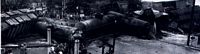
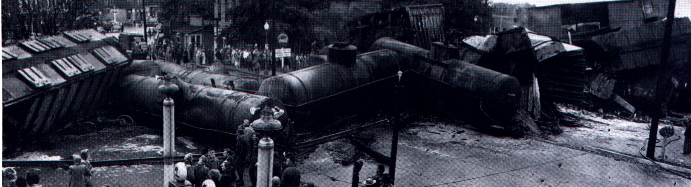
Photo from Lowell Centennial book. Photo
believed to have been taken by Jim Baker
Special thanks to Mrs. Harold Snyder, Lowell,
Indiana for use of the 1952 Centennial Book.
Return to main page